
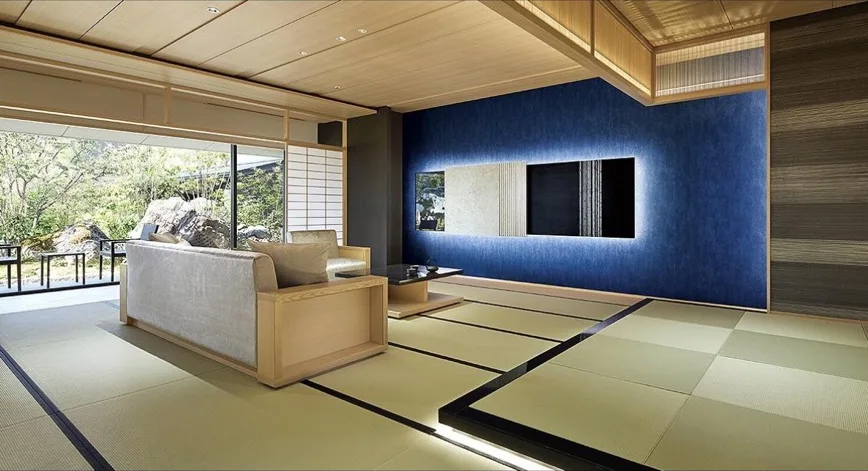
The greatest benefit of adding tatami guest rooms — washitsu or Japanese-modern style — to a hotel or ryokan is that they let you differentiate on “an authentic Japan experience you can only get here,” while also supporting higher average daily rates and stronger review scores. For international visitors, a tatami room is not just accommodation; it is the very embodiment of “sleeping in Japan.” That makes it a powerful tool for escaping price competition. Here are the seven concrete effects to know. (Actual results vary by location, guest mix, and operation.)
1. A Decisive Edge for Inbound Tourism
What travelers from overseas come to Japan for is, above all, the kind of authentic Japanese experience that tatami and washitsu represent. On booking platforms, a tatami guest room stands out at a glance among rows of standard Western rooms. A room that says “you’re in Japan” without a word of explanation accelerates the booking decision.
2. Easier to Push Average Daily Rate (ADR) Higher
Tatami rooms position naturally as “special” accommodations, making a premium rate easier to justify than for a Western room of equal floor area. The intrinsic value of a Japanese aesthetic — beyond mere view or square footage — gives guests a satisfying reason to pay more.
3. Stronger Review and Rating Performance
The scent, texture, and quietness of tatami stay with guests long after checkout. The satisfaction of “that room felt genuinely Japanese” can translate into high-rating reviews, return visits, and word-of-mouth referrals — potentially compounding into a long-term asset for guest acquisition.
4. Igusa Comfort: Humidity Regulation, Odor Absorption, and Relaxation
Igusa (rush grass) tatami absorbs excess moisture from the air and releases it when conditions dry out, providing natural humidity regulation. It also traps airborne odors, and the distinctive scent of fresh igusa is widely noted for its relaxation effect. The room environment itself becomes an act of hospitality. See the tatami material guide for a deeper look.
5. Safety and Quiet
Tatami has a gentle give that cushions falls, offering reassurance for families with young children or elderly guests. Its natural sound absorption — dampening footsteps and ambient noise — is especially valued by guests who prioritize a peaceful stay.
6. A Versatile, Multi-Purpose Room Design
A tatami room doubles as a bedroom when futon bedding is laid out, and as a living or working space when it is put away. This flexibility maximizes the value of limited floor area, making it viable even for compact urban properties.
7. A Consistent Brand World
Connecting tatami guest rooms to a Japanese-toned lobby and common areas creates a coherent sense of place across the entire property. A fully realized Japanese aesthetic — authentic materials, craftsmanship, and design intent — photographs and films exceptionally well, amplifying reach on social media.
Getting Started
The ideal tatami type (igusa, washi, or resin), dimensions, and fire-resistance specifications vary with your property’s use case. HASUNOMA supports you end-to-end: from washitsu design and material sourcing to tatami export for overseas properties. Get in touch to begin the conversation.
Frequently asked questions
- What is the single biggest benefit of adding tatami rooms to a hotel?
- The greatest benefit is differentiation through an authentically Japanese experience that cannot be replicated elsewhere. Tatami guest rooms are highly photogenic and can attract direct bookings, support higher room rates, and contribute to stronger review scores — though actual outcomes vary by location, guest mix, and operation.
- Do tatami rooms outperform standard rooms in occupancy?
- It depends on location and guest mix, but properties with a high share of international visitors tend to see tatami and Japanese-modern rooms attracting targeted bookings and sustaining occupancy during low seasons. Many properties now offer both room types to serve different guest segments.
- Are tatami rooms difficult to maintain?
- Day-to-day care is simply dry-wiping along the weave and regular ventilation — nothing burdensome. When planned renewal costs such as surface re-covering (omote-gae, roughly every 4–7 years) are budgeted in advance, the long-term maintenance cycle is often more manageable than Western carpet.
Considering a Japanese space?
Contact us