
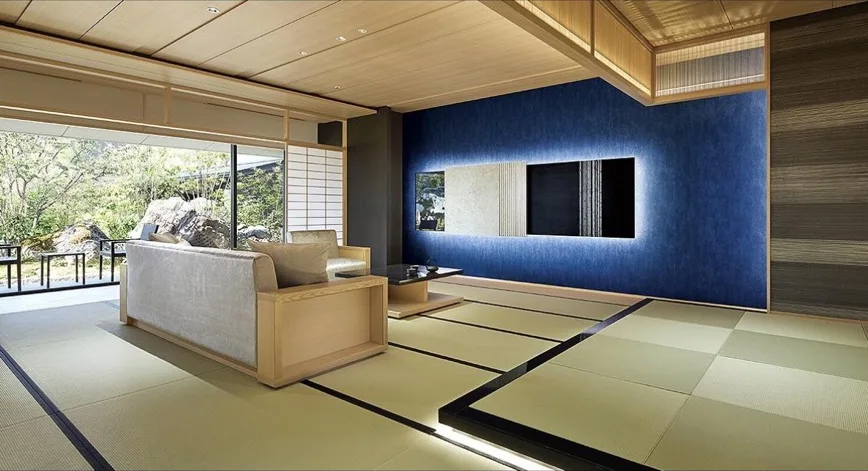
Choosing tatami for a guest room comes down to a clear three-way trade-off: authentic texture and scent (igusa) / resistance to fading and fraying plus a wide color palette (washi tatami) / maximum resistance to water and staining with easy cleaning (resin tatami). Match your choice to what your property stands for and how much maintenance your team can manage. Here is a side-by-side look at each option.
Igusa Tatami (Natural Rush Grass)
The classic, woven from natural igusa rush. Its greatest strengths are the ones no manufactured material fully replicates: natural humidity regulation, odor absorption, and the scent of fresh rush that triggers immediate relaxation. The trade-offs are discoloration from sun exposure, some color transfer when new, and vulnerability to moisture. Plan for regular surface re-covering (omote-gae). It is the ideal choice when the authentic Japanese experience is the product itself.
Washi Tatami
The tatami face here is woven from paper cord (twisted washi) coated with a resin finish. It is strongly resistant to fading, fraying, mold, and dust mites, with a far broader range of colors and patterns than igusa — a natural fit for Japanese-modern borderless room designs. It does not deliver the same scent or humidity-regulation performance as igusa, but it is an excellent choice for high-occupancy rooms where you want the look to stay fresh over time.
Resin Tatami
The face is woven from polypropylene or similar synthetic material. It is the most resistant of the three to water, staining, and abrasion, and the easiest to wipe clean. Scent and humidity regulation are not features to expect here, but it shines in settings where cleaning frequency is high or the room is near wet areas.
At a Glance
| Criterion | Igusa | Washi | Resin |
|---|---|---|---|
| Authentic texture & scent | ◎ | ○ | △ |
| Humidity regulation & odor absorption | ◎ | △ | △ |
| Resistance to fading & fraying | △ | ◎ | ◎ |
| Resistance to water & staining | △ | ○ | ◎ |
| Color & pattern variety | ○ | ◎ | ○ |
The table reflects general tendencies; individual products vary.
Bordered vs. Borderless (Ryukyu-Style) Panels
Laying square borderless panels in a checkerboard orientation creates a sophisticated Japanese-modern impression. All three materials are available in this format, so design intent and material properties are not mutually exclusive. Let the room’s concept be your guide.
Not Sure Which to Choose?
The right tatami for each floor or room category depends on your occupancy rate, guest profile, housekeeping capacity, and brand vision. HASUNOMA guides you through material selection as part of a complete Japanese-room design proposal — from creating the washitsu guest experience through planning your replacement and maintenance cycles. Contact us to get started.
Frequently asked questions
- What is the main difference between igusa, washi, and resin tatami?
- The distinction comes down to material origin and durability. Igusa (natural rush grass) excels at humidity regulation and delivers an authentic scent; washi tatami resists fading and fraying and offers a wide range of colors and patterns; resin tatami is the most resistant to water and staining and the easiest to keep clean. Igusa wins on authenticity of feel; washi and resin win on ease of maintenance.
- Which tatami material is best suited to hotel guest rooms?
- If the authentic Japanese experience is your core selling point, choose igusa. If you need appearance to hold up under high occupancy and resist fading or wear, choose washi tatami. For areas requiring frequent cleaning or close proximity to water, resin tatami is the practical choice. Many properties use different materials on different floors or in different room categories.
- What are borderless tatami (ryukyu-style) panels?
- These are square panels without the traditional fabric border (heri), laid in a checkerboard pattern for a refined Japanese-modern look. They can be made in igusa, washi, or resin, so you can combine the aesthetic with whichever material properties you need.
Considering a Japanese space?
Contact us