
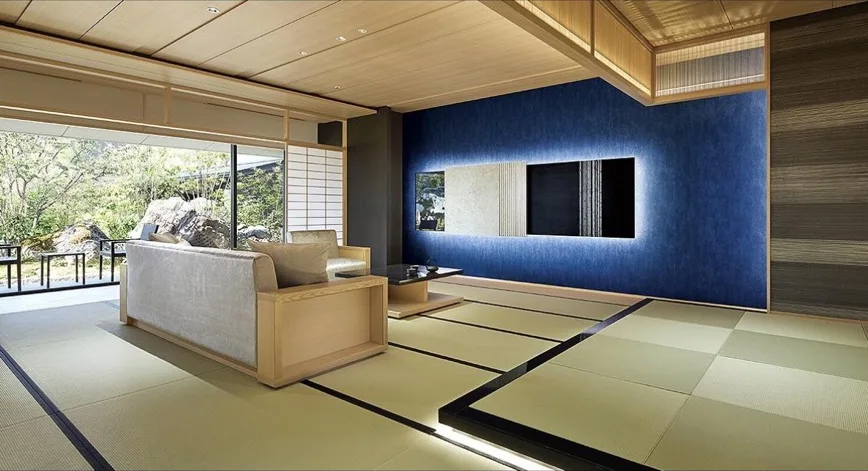
The foundation of tatami maintenance is built on a three-stage renewal cycle — turning (3–5 years), re-covering (4–7 years), full replacement (10–20 years) — planned into your operations from the start, combined with day-to-day dry-wiping and ventilation to prevent moisture build-up. Work these into your routines and tatami will hold both its beauty and its function for the long term. Here is a practical breakdown for hospitality operators.
Understanding the Three Renewal Stages
- Turning / ura-gaeshi (benchmark: 3–5 years): The tatami face is flipped to reveal the unused underside, restoring a near-new appearance at minimal cost. The lightest update in the cycle.
- Re-covering / omote-gae (benchmark: 4–7 years): The woven face and border fabric are replaced with new material while the base (tatami-doko) is kept. Appearance is thoroughly renewed at lower cost than full replacement.
- Full replacement / shincho (benchmark: 10–20 years): The entire tatami — base and face — is replaced from the ground up. The right choice when the base has become compressed or damaged beyond recovery.
These are general benchmarks. Actual intervals will vary with room occupancy and usage intensity. High-occupancy hotel rooms should be planned on a shorter cycle than residential tatami.
Thinking About Running Costs
The right frame for tatami cost is not “upfront expense” but “total cost of ownership including renewals over time.” Because the base can be reused at the re-covering stage, planned renewals can actually spread costs more evenly than a full floor replacement would. Calculate an annual renewal budget by multiplying number of rooms by the renewal cycle, and schedule work during low-occupancy periods to minimize disruption. For how material choice affects durability, see the tatami material guide.
Day-to-Day Care
- Dry-wipe along the weave: Use a dry cloth or flat mop, working with the grain of the tatami surface.
- Ventilate regularly: Open windows or run air circulation to expel moisture. Moisture is the primary cause of mold and dust mites.
- Damp-wiping — sparingly: For visible stains, use a cloth wrung out thoroughly. Dry completely immediately after.
- Manage direct sunlight: Excessive sun accelerates fading. Use curtains or blinds to moderate exposure.
Building Care Into Housekeeping Operations
Adding “dry-wipe along the weave” and “ventilate” to your room-cleaning checklist ensures consistent quality across all staff. Tracking re-covering and replacement dates for each room in a log prevents missed renewals and avoids the disruption of unexpected deterioration.
Comprehensive Support from HASUNOMA
HASUNOMA supports you from creating your washitsu guest rooms and material selection through to planning renewal cycles and ongoing maintenance. Contact us to discuss how to structure your tatami upkeep program.
Frequently asked questions
- How often does tatami need to be replaced?
- The general benchmarks are turning (ura-gaeshi) at 3–5 years from first use, surface re-covering (omote-gae) at 4–7 years, and full base replacement (shincho) at 10–20 years. In high-occupancy hotel guest rooms these intervals will be shorter than in a private home.
- What is the difference between turning, re-covering, and full replacement?
- Turning (ura-gaeshi) means flipping the tatami face to use the unused underside — the lightest and least expensive renewal. Re-covering (omote-gae) replaces the woven face and the border fabric with new material while keeping the base (tatami-doko) intact, at moderate cost. Full replacement (shincho) replaces the entire tatami — base and all — and is the most comprehensive and most expensive renewal.
- What does day-to-day maintenance involve?
- The fundamentals are dry-wiping along the weave and regular ventilation. If damp-wiping is needed for stains, wring the cloth out thoroughly and make sure the tatami dries completely afterward. Excessive direct sunlight accelerates fading.
Considering a Japanese space?
Contact us