
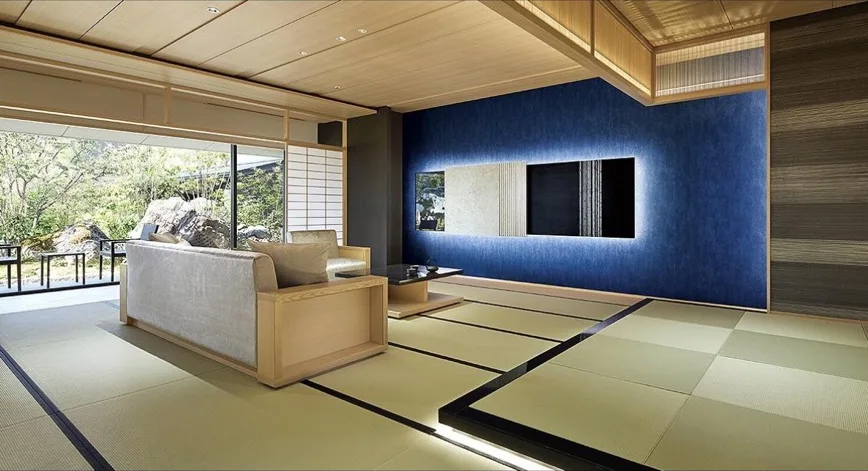
The reason a washitsu room elevates the guest experience and review scores is that the Japanese room environment — centered on tatami — works on all five senses, creating the kind of memory that makes guests feel they had “a special stay they could only have here.” That satisfaction converts into high-rating reviews and the long-term guest acquisition assets of return visits and word-of-mouth referrals. Here is how the mechanism works, and the design decisions that make it happen.
It Stays in Memory Because It Reaches All Five Senses
- Smell: The scent of igusa tatami invokes Japan instantly, shaping the first impression the moment a guest steps through the door.
- Touch: The texture and gentle give of tatami underfoot is the sensory signal that tells the body to relax.
- Hearing: Tatami and shoji screens absorb sound, creating a quiet environment that feels removed from the outside world.
- Sight: Natural materials and negative space — what is deliberately left empty — give the room a composed, otherworldly calm.
Price and location are factors guests compare easily. A multisensory experience like this is a form of differentiation that cannot be replicated elsewhere.
Experience Becomes the Language of Reviews
Guests write about the moments that moved them. “The tatami room was extraordinary.” “It felt like a genuinely Japanese experience.” Words like these appear in reviews and pull the next guest’s hand toward the booking button. The washitsu is a guest room designed to give people something worth writing about. For the inbound tourism angle, see 7 benefits of tatami in hotels.
Four Design Decisions That Lead to Strong Reviews
- Make tatami the protagonist: The material is the core of the experience. Choosing the right tatami for the room’s purpose is the starting point (see the material guide).
- Control the light: Soft, diffused light through shoji screens or indirect fixtures creates a sense of calm that overhead lighting cannot.
- Preserve negative space: A restraint that shows the tatami surface — less furniture, not more — conveys refinement and allows the room to breathe.
- Design for flexibility and flow: The ability to shift from sleeping to lounging to working by simply changing what is laid out on the floor enriches how a guest inhabits the room.
Consistency Between Guestrooms and Common Areas
When the Japanese tone extends from the guest room into the lobby and corridors, the stay becomes a single coherent narrative. A fully realized aesthetic also photographs and films beautifully, amplifying reach when guests share their experience on social media.
Designing Your Japanese Spaces Together
HASUNOMA supports you from material selection through to the design of guest rooms and common areas as complete Japanese-room environments. Contact us to discuss how to build the kind of guest experience that earns strong reviews.
Frequently asked questions
- Why do washitsu rooms tend to generate higher review scores?
- The sensory experience of tatami — its scent, texture, and quietness — is the kind of memory that stays with guests. The satisfaction of "that was a genuinely Japanese stay unlike anything else" reliably converts into high-rating reviews, return visits, and personal referrals.
- How does guest satisfaction differ between washitsu and standard Western rooms?
- A washitsu provides "an experience you can only have in this country," which makes it easier for guests to feel they received more value than they paid for. This effect is especially pronounced for international visitors and guests celebrating a special occasion.
- Can the appeal of a washitsu be achieved in a small space?
- Yes. With tatami, shoji screens, indirect lighting, and a considered use of negative space, even a compact guest room can express a full sense of Japanese atmosphere. Editing down to fewer elements, each of high quality, tends to produce better results than adding more.
Considering a Japanese space?
Contact us